Study’s Kinematics
This page briefly summarizes the key concepts that Eduard Study (1862 - 1930) introduced in the field of kinematics by him [1]. It brings a model of minimal dimensionality to describe the Special Euclidean group SE(3), the group of proper rigid body motions [2].
This model is closely related to Dual Quaternions Algebra.
The tuple \(\mathbf{p} = (p_0 : p_1 : p_2 : p_3 : p_4 : p_5 : p_6 : p_7)\) of homogeneous coordinates in the 7-dimensional projective space \(\mathbb{PR}^7\) is also known as the Study parameters or the Study’s vector, and it lies on the Study quadric.
Study Quadric
The Study quadric is a 6-dimensional quadric in the 7-dimensional projective space \(\mathbb{PR}^7\) defined by the equation, also known as the Study condition:
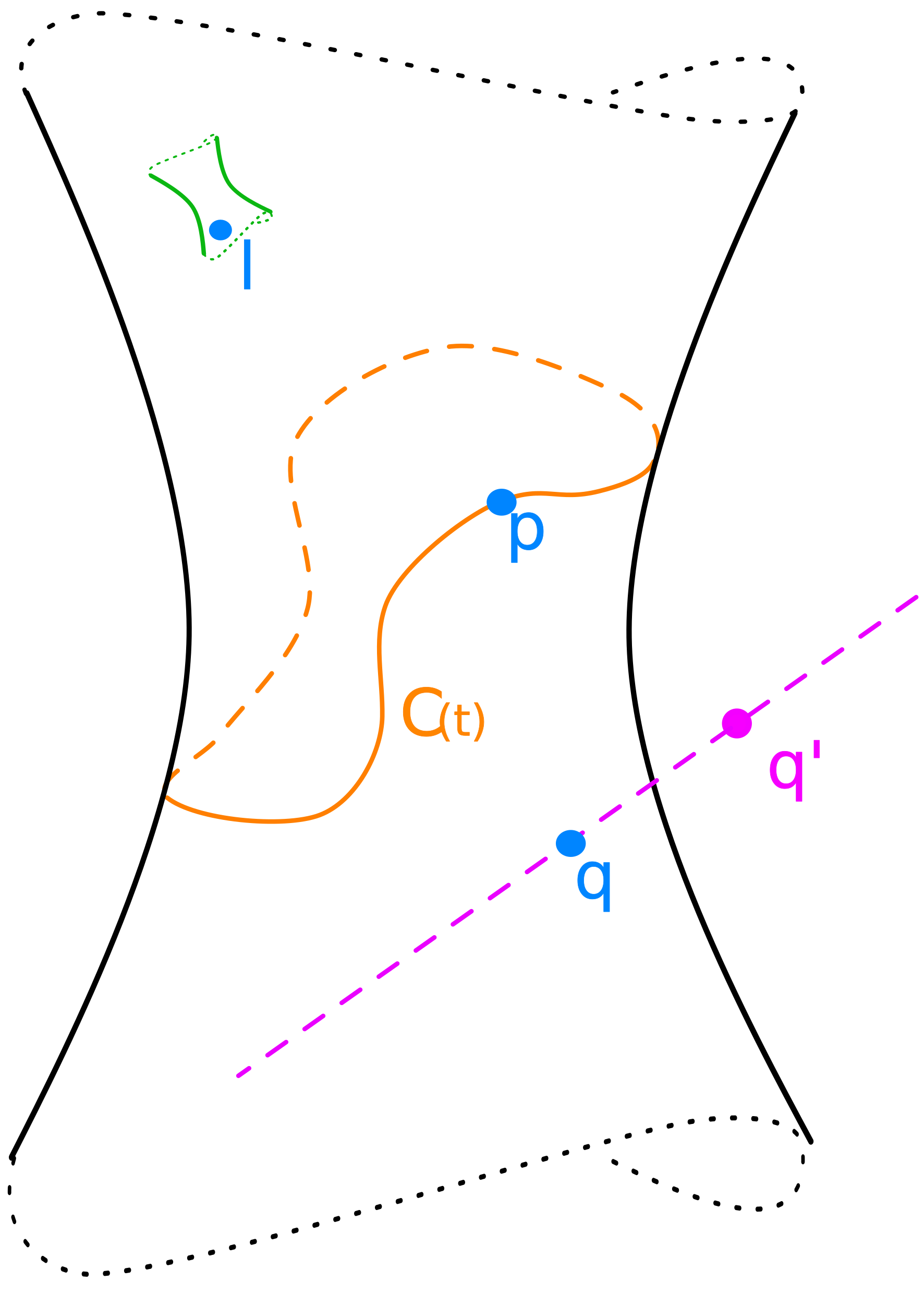
Visualization of Study quadric; regular points (dual quaternions) are in blue, pink point \(\mathbf{q}'\) is out of the quadric but can be back-projected as \(\mathbf{q}\). \(C(t)\) is a motion curve going through point \(\mathbf{p}\). Point \(\mathbf{l}\) is dual quaternion representing line on the Plücker quadric (green), that is also contained in the Study quadric.
A point \(\mathbf{p}\) lies on the Study’s quadric if and only if its elements satisfy the Study condition.
There are elements of the Study’s quadric that are not representing a ridig body transformation. They lie in a 3-space on the quadric that fulfills the equation:
This 3-dimensional space is also called the exceptional generator or the null quadric.
References: