Rational Motions and their Factorization
This section describes the concept of rational curves and motions in the space of dual quaternions. It also introduces the factorization of motions into a sequence of linear factors that represent rotations.
Rational Curve and Motion
The class RationalCurve is used to represent rational curves.
A single point \(\mathbf{p}\) on the Study quadric describes a discrete transformation. A curve \(C(t)\) on the Study quadric describes a 1-parametric rigid body motion in SE(3). If all point trajectories are rational curves, \(C(t)\) is called a rational motion parametrized by \(t\). It is given by a polynomial \(C(t)\) with dual quaternion coefficients. An example of a rational motion follows
which is a continuous curve in the space of dual quaternions describing position and orientation of a rigid body. The parameter \(t\) is a real number, and can be mapped to a 360 deg rotation around the z-axis, i.e. the variable angle \(\theta\) of a joint axes. This mapping is in detail described in the section Joint Angle to Curve Parameter.
Motion Factorization
The tutorial on Motion Factorization describes the basic usage provided by this package. The methods are based on two papers by Hegedüs et al.[1] and [2].
If a curve \(C(t)\) is given, under certain conditions it can be factorized into linear factors, which represents simple rotations and translations. Since the translations are difficult to realize in engineering applications, this package focuses on the factorization of rotations.
The factorization is handled in the background by Biquaternion_py package, whose author is Daren A. Thimm. Refer to the package documentation for more details.
As an example, let’s use the same curve as in ARK 2024 Paper - Extended Information:
This rational curve represents a proper rigid body motion in SE(3) of degree 2. Applying the factorization technique, the curve can be factorized into a sequence of following linear factors:
The two factorizations \(f_0\) and \(f_1\) represent two branches of a serial mechanism, which can be connected in the base and tool frame to create a single-loop (parallel) mechanism, in this case it is a 1-DoF Bennett mechanism, where parameter \(t\) represents a driving joint angle (the 1-DoF). The output can be visualized as shown in the following figure.
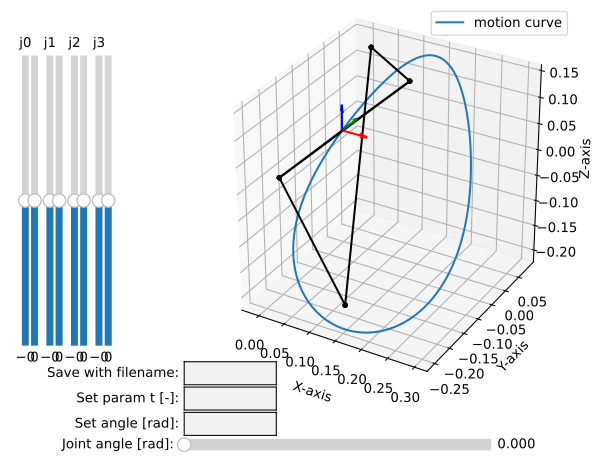
The dual quaternions \(\mathbf{h}_1, \mathbf{h}_2, \mathbf{k}_1, \mathbf{k}_2\) represent the rotational joints of the mechanism, and are related to their Plücker coordinates. In the presented example, the dual quaternions have the following form:
References: