Homogeneous Points
The class PointHomogeneous is used to represent points in n-dimensional space.
A 3D point with coordinates \((x, y, z)\) in Eucledian space \(\mathbb{R}^3\) can be represented as a 4D point in homogeneous space \(\mathbb{R}^4\) as \((w, x, y, z)\).
3D points can be embedded into dual quaternion space in the following way:
where \(SE(3)\) is the special Euclidean group of rigid body transformations in 3D space.
How dual quaternions act on points can be found in DQ Action on a Point.
Normalized Lines
The class NormalizedLine is used to represent lines.
A line in 3D space can be represented using Plücker coordinates. These are six-dimensional vectors \(\mathbf{l}=(g_0, g_1, g_2, g_3, g_4, g_5)\). The line’s direction is \(\mathbf{g}=(g_0,g_1,g_2)\), its moment vector \(\overline{\mathbf{g}} = (g_3,g_4,g_5)\) is obtained as
where \(\mathbf{q}\) is an arbitrary point on the line. Plücker coordinates fulfill the Plücker condition
Normalized line then corresponds to Plücker coordinates with the condition, that
i.e. the direction vector is normalized. More on Plücker coordinates can be found in Pottmann and Wallner[1].
Lines can be embedded into dual quaternion space in the following way:
How dual quaternions act on lines can be found in DQ Action on a Line.
Dual quaternions that correspond to lines can be interpreted as the half-turn transformations, i.e. transformations that rotate the origin by 180 degrees around the line. The following code snippet plots the half-turn transformation corresponding to a line in 3D space.
from rational_linkages import Plotter, DualQuaternion, NormalizedLine, PointHomogeneous
from copy import deepcopy

pt1 = PointHomogeneous([1, 0.3, 1, 0])  # w = 1, x = 0.3, y = 1, z = 0
pt2 = PointHomogeneous([1, 0.3, 1, 1])  # w = 1, x = 0.3, y = 1, z = 1
l = NormalizedLine.from_two_points(pt1, pt2)

dq1 = DualQuaternion(l.line2dq_array())

dq2 = deepcopy(
    dq1)  # alter the rotation part of the dual quaternion to get some other transformation
dq2[0] = 2

p = Plotter(arrows_length=0.5, backend='matplotlib')
p.plot(l)
p.plot(pt1, label='pt1', color='red')
p.plot(pt2, label='pt2', color='red')

p.plot(DualQuaternion(), label='origin')
p.plot(dq1, label='half-turn')
p.plot(dq2, label='some-rotation')
p.show()
We can additionally see that if we alter the zero element of dq1 to get dq2, we get a transformation
that corresponds to some rotation around the line, but not a half-turn transformation anymore.
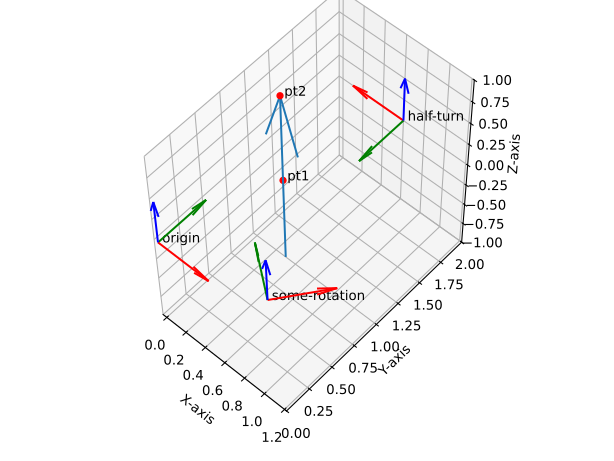
Half-turn transformation corresponding to a line in 3D space
References: